What PE investors miss in healthcare commercial due diligence
Healthcare private equity just had a record year. The financial model is rarely what goes wrong. Five commercial questions investors should test before they sign.
 Emilio Fernandez, Owner & CEO
· 4 min read

I have looked at deals from both sides: as a corporate buyer screening thousands of assets, and as an advisor evaluating healthcare and biotech investments. The pattern is consistent. The financial model is usually well built. What goes wrong is the commercial story underneath it: who will prescribe, who will pay, how fast adoption really happens, and whether the organization can deliver the plan.
A crowded, competitive market
Healthcare private equity is busy. Bain & Company estimates that global healthcare PE deal value reached a record $191 billion in 2025, with about 445 buyouts announced, the second-highest count on record. Biopharma deal value rose to an estimated $80 billion from $55 billion, and provider and related services rose 57% to about $62 billion, with healthcare IT inside that segment rising to about $32 billion.
Bain also notes that, with consistently high valuations and competitive deal dynamics, the investors best positioned to win are the ones focused on a few targeted value-creation levers. When prices are high, the commercial thesis has to be right. Here are the five places I see it go wrong most often.
1. Treating the market as a number, not as people
Top-down market sizing tells you how big the opportunity could be. It does not tell you how many prescribers, clinics or buyers will actually change behavior, and how fast. Good diligence rebuilds the forecast from the bottom up: the patient or customer journey, the decision makers at each step, and the realistic share of each segment you can win.
2. Underestimating access and pricing risk
In pharma and medtech, the payer often decides more than the physician. Diligence should test coverage, contracting and channel economics, not just list price. Policy belongs in the model too. Under Medicare drug price negotiation, KFF explains that high-spending, single-source drugs can be selected once they are at least 7 years (small molecules) or 11 years (biologics) past approval. For any asset with long-dated cash flows, that clock changes the value.
3. Assuming launch execution will match the plan
Many healthcare theses depend on a launch or an expansion that has not happened yet. McKinsey found that only 20 to 30 percent of first-time launchers exceeded launch expectations, compared with 40 to 50 percent of established companies. If the value-creation plan assumes a first-time team will launch like a large pharma company, the plan needs a second look, and probably a stronger commercial leader.
4. Ignoring the evidence and lifecycle plan
A product's first indication is rarely its whole story. IQVIA found that launch success for emerging companies is most often associated with evidence development beyond initial approval, realistic product assessments and efficient promotion, and that follow-on approvals drive sustained growth. Diligence should ask what evidence is coming, when, and what it costs, not only what the label says today.
5. Underweighting People, Culture and Adoption
This is the one I see missed most. Founder-led healthcare businesses often run on the founder's relationships and judgment. After the deal, the plan asks the same team to grow faster, add structure and report differently. If key people leave, or the team never really buys into the new plan, the numbers do not follow. In buy-and-build strategies, the risk multiplies with every add-on. Bain observes that leading physician-group platforms are moving beyond traditional buy-and-build toward more integrated, clinician-centric models, which makes integration capability part of the investment case.
What good commercial diligence delivers
- A bottom-up forecast, built from customers and prescribers, that you can defend to an investment committee.
- A clear view of access, pricing and policy risks, with the downside cases quantified.
- An honest assessment of the commercial team and the leaders the plan will need.
- A 100-day value-creation plan that the management team helped shape and believes in.
The formula view
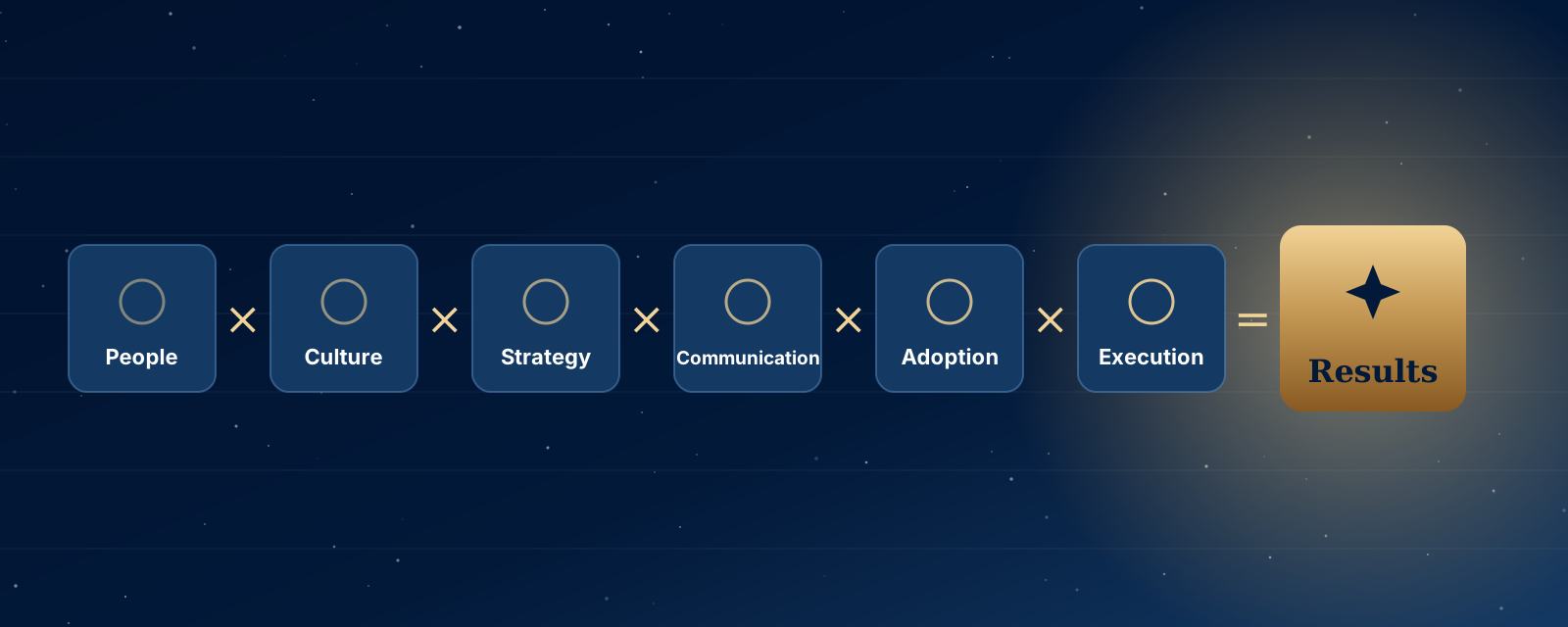
I use the Scalar Formula, People × Culture × Strategy × Communication × Adoption × Execution = Results, as a diligence lens. Most models test Strategy and assume the rest. Because the factors multiply, a weak team or a plan the organization does not adopt can erase the value of a strong market. The investors who win in a crowded market will be the ones who test all six before they sign, and build the value-creation plan around them afterwards.
General commentary based on public sources, not investment, legal or regulatory advice.
Sources
- Bain & Company, Global Healthcare Private Equity Report 2026: Resurgence and Record Growth (January 2026)
- KFF, Key Facts About Medicare Drug Price Negotiation
- IQVIA Institute, Expanding Options for Emerging Biopharma in the U.S.: A Decade of Change (October 2025)
- McKinsey, Small but mighty: priming biotech first-time launchers (November 2024)
Figures are as reported by the sources above, accessed October 2026.
Recommended for: Investors and BD / M&A