The Scalar Formula: why results multiply, and why one zero sinks them all
People × Culture × Strategy × Communication × Adoption × Execution = Results. Why the signs matter, and how to strengthen each factor.
 Emilio Fernandez, Owner & CEO
· 4 min read
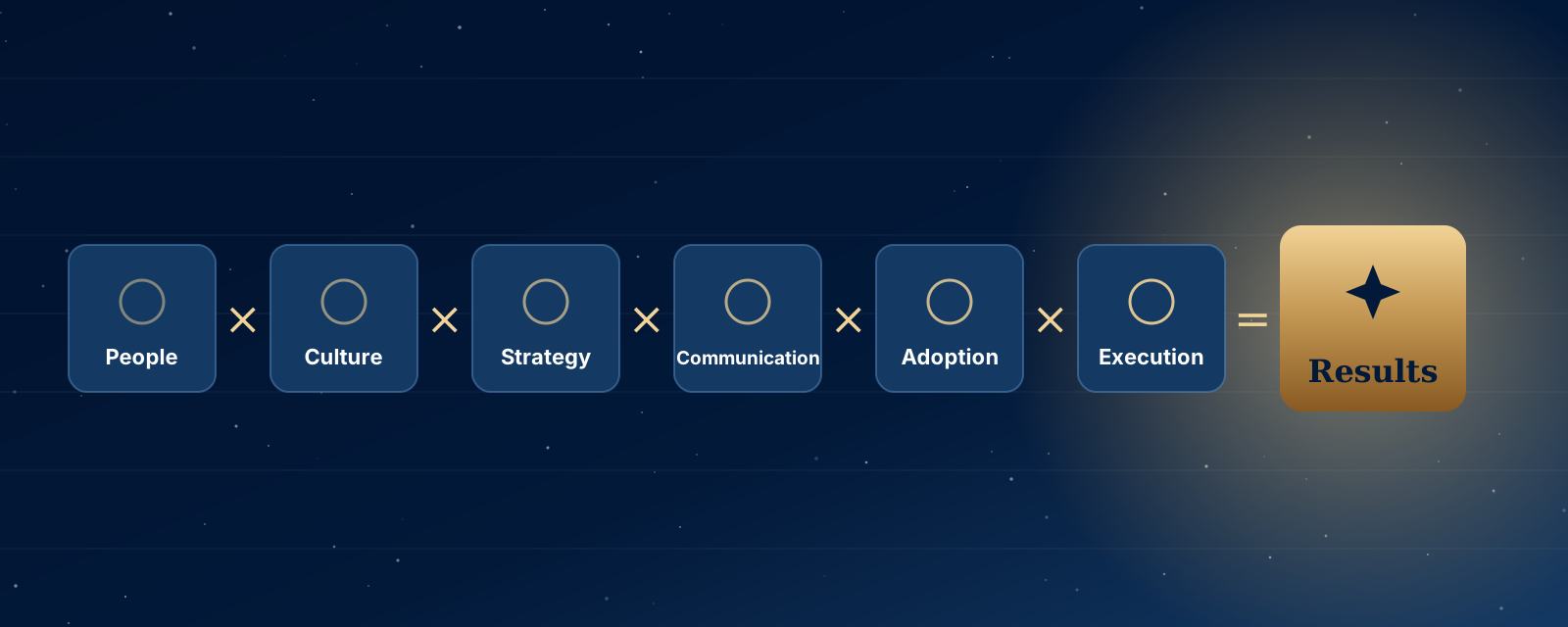
Over two decades in commercial leadership, I have seen strong businesses stall and ordinary-looking ones break out. When I look back at what separated them, it was rarely a single brilliant idea. It was the combination of six things, and the way they interact. I now write it as a formula, and it sits at the center of how Scalar works:
People × Culture × Strategy × Communication × Adoption × Execution = Results
The most important part of the formula is not any one word. It is the sign between them.
Why multiply, not add
If results were the sum of these factors, you could make up for a weak one by overinvesting in another. A brilliant strategy could compensate for a disengaged team. A great product could make up for a confused message. In my experience, that is not how businesses behave.
The factors multiply. Strength in each one compounds the others: the right people make the culture, the culture makes the strategy real, clear communication spreads it, adoption makes it everyone's plan, and disciplined execution turns all of it into numbers. And the reverse is just as true. If any one factor is close to zero, the product collapses toward zero, no matter how strong the other five are. Weakness anywhere caps the whole.
That has a practical consequence. The highest-return move is often not to push your strongest factor further. It is to find your weakest one and lift it.
People: the right leaders in the right seats
Everything starts with people. Not headcount, but the right leaders in the right roles, with a team shaped for the stage the business is entering rather than the one it is leaving.
In practice: map your critical roles against the next stage of growth. Ask, for each one, whether the person in the seat would be your choice if you were hiring today. Fill gaps early; the cost of waiting is usually higher than the cost of acting.
Culture: ownership and urgency
Culture is how decisions actually get made when nobody is watching. The cultures that scale combine ownership (people treat the result as theirs) with urgency (they act before they are asked) and the courage to make the call.
In practice: watch how bad news travels. If it arrives late, softened or not at all, culture is the factor holding you back. Leaders set the tone by rewarding candor and by deciding quickly.
Strategy: choosing where to win
Strategy is choice. Which customers, which segments, which markets, and just as important, what you will not do. A strategy that tries to win everywhere is not a strategy.
In practice: write your strategy on one page. If the team cannot repeat the top three priorities and the one thing you have decided to stop, it is not yet clear enough to execute.
Communication: one clear story, inside and out
The best strategy in the world is worth little if the organization hears five versions of it. Communication means one clear story, told consistently to your teams, your customers, your partners and your board.
In practice: test the story at the edges of the organization. Ask a field leader, a new hire and a key customer what the business stands for. The gap between their answers and yours is the work.
Adoption: understood and bought in
A strategy only works when the people who carry it out understand it and believe in it. Adoption is both halves: understanding (people know what the plan is, why it matters and what it means for their own work) and buy-in (they commit to it rather than simply comply). Communication sends the message; adoption is whether it lands and sticks.
Low adoption is easy to miss from the top. The plan was presented and everyone nodded, yet decisions in the field still follow the old priorities. That is a zero hiding in plain sight.
In practice: involve the people closest to customers before the plan is final, so it carries their insight. A few weeks in, check whether teams can explain it in their own words and name what they now do differently. Where they cannot, listen before you push harder.
Execution: disciplined cadence and accountability
Execution is where plans become results. It is not heroics. It is a steady operating rhythm, clear owners, a small set of measures that matter, and the discipline to review them and act.
In practice: for every priority, name one owner, one measure and one date. Review them on a fixed cadence. When something slips, decide what changes, not just who is late.
Finding your zero
When I start working with a leadership team, the first question I ask is not "what is your strategy?" It is "which of these six is weakest right now?" Leaders usually know. The answer is often uncomfortable, which is exactly why it is valuable.
A quick way to begin: score each factor honestly on a simple scale with your leadership team, independently, then compare. Where the scores differ most, you have found a conversation worth having. Where they are lowest, you have found your next priority.
Results multiply. So does weakness. The businesses that keep scaling are the ones that refuse to leave a zero anywhere in the formula.